How to Play Omaha Poker

For many poker players who start out learning how to play Texas hold'em, Omaha poker is often the next game to discover.
If you are thinking to explore this poker variant and you would like to learn how to play Omaha poker, this beginner's guide to the game gives you everything you need.
Continue reading to find:
- An introduction to the game
- How to play Omaha poker
- The hands in Omaha poker
- The main differences between Omaha poker and Hold'em
- Where to play Omaha poker games online?
Here we go over the poker rules for Omaha Poker
Check out the rules and basic strategy to all the popular poker formats
1. What is Omaha Poker?
The more you play poker, the more you keep hearing how Omaha poker is the game to play to get the best action and challenge the best players.
In the past 10 years or so, Omaha poker became one of the most popular poker variants. Some go as far as to say that Omaha poker (PLO, specifically) it's on a trajectory to surpass Texas hold'em and become the most played game in the world.
Part of the game's success has to do with its rules. Like most poker games, the basics of Omaha poker are the same as those in Texas hold'em - meaning that if you know how to play one, you are in a good spot to play the other.
When it comes to Omaha poker, there are different sub-variants out there, each with its specificities and dedicated players base.
The two most popular types of Omaha poker (i.e. those you'll find at every major poker site) are:
- pot-limit Omaha (PLO)
- Omaha hi-lo
This guide on how to play Omaha poker focuses on pot-limit Omaha (PLO) poker, one of the most played games of the year and probably the easiest version of the game to learn as a beginner.
If that's not what you are looking for or if you are already fluent in PLO poker, you can read about Omaha hi-lo poker rules here.
2. How To Play Omaha Poker
To play a game of Omaha poker you'll need a 52-card deck of French cards. Also, unless you are in for an old-fashioned game with beans, buttons, and pennies, you'll need also some poker chips, a dealer button, and two blinds buttons.
A game of Omaha poker needs two to ten players to begin.
Want to up you home games? Use this collection of all the best poker chip sets on Amazon to organize the perfect games of Omaha poker at home!
Like in other poker games, the action of a hand of Omaha poker includes several betting rounds and a combination of private ('hole') and community cards ('the board).
The first thing you want to remember when it comes to learning how to play Omaha poker is the name of the different phases that compose a hand.
- The pre-flop: The initial betting round. Some players (the 'Blinds') are obliged to place a bet while the others can decide wether to call, fold, or raise.
- The flop: The second betting round. The players still in the hand decide how to act once the dealer places the first three community cards on the board, face up.
- The turn: The third betting round. The players still in the hand decide how to act once the dealer places the one more community card on the board, face up.
- The river:The last betting round. The players still in the hand decide how to act once the dealer places the last the five community cards on the board, face up.
- The showdown: The players still in the hand reveal their cards.
Preflop Action
The Big Blind (BB) and the Small Blind (SB) place their bets on the table so the action can start.
The dealer distributes four cards to each player, all face down. As we will see later, this is one of the key differences between Omaha and Texas Hold'em poker.
As soon as all the cards reached the respective players, the first betting round begins. The first player to act is the one at the left of the Big Blind (table position: 'Under the Gun' or UTG).
The action continues clockwise until it reaches the Big Blind.
All players have the following options:
- Call: They place a bet equal to the size of the Big Blind (or to the highest bet that was placed before them, in case someone in the hand decided to raise).
- Raise: They increase the bet making it more expensive for other players to stay in the hand.
- Fold: They give back the card and leave the hand.
The Flop
The dealer places three cards on the board, all face up. These are the first of a series of five that the players need to use to build their final poker hand.
As soon as the three cards are on the table, a new betting round begins.
The Flop betting round is identical to the previous one.
The Turn
The dealer places one more card on the board, again face up. All the players still in the hand enter a new betting round that develops exactly as the previous one.
The River
The dealer places the last community card on the table, face up, and a new betting round follows.
If there are still two or more players in the hand, the action continues to the final chapter (the 'Showdown). It most player fold, the hand goes to the last-one standing.
The Showdown
The players in the hand turn their hands over, and use at most two of their hole cards in combination with any of the five on the board to build a five-card poker hand.
The player with the highest poker hand is the one who wins the hand and takes down the pot.
And here's where most beginners get in trouble.
Players that are just starting to learn how to play this game and are not too familiar with the Omaha poker rules tend to make a lot of mistakes when it comes to building five-card hands.
The most common PLO poker mistake people make when they learn how to play Omaha poker is to forget they need to use at least two of the four hole cards to build their final hand.
Play online poker games on the top online poker sites and join thousands of other players in exciting games of Texas Hold'em, Omaha, and more!
Let's look at one example.
A player holding A♥Q♣7♦6♦ looks at a board of 9♥4♥2♣J♥Q♥ thinking he has made the nuts with an ace-high flush.
That's a mistake.
The Omaha poker rules do not allow you to make a hand using only one hole card (A♥) in combination with four community cards (the four hearts on the board).
In fact, this player only has a pair of queens, not a flush.
How to Bet in Omaha Poker
Another factor to consider when it comes to Omaha rules is how betting works. And that's because there are some key differences between Omaha poker and Hold'em — and not being aware of them could cost you a lot of precious chips.
Like in hold'em, the minimum bet allowed in Omaha is always the equivalent of the big blind.
In a $1/$2 PLO poker game, the minimum a player can bet is $2.
However, while in no-limit hold'em player can always bet all their chips at any point, the maximum bet allowed in PLO is the size of the pot.
Calculating what exactly is a "pot-sized" bet can be trickier and it often needs the help of the dealer.
If the pot is $10 and a player is the first to act, the calculation is easy: the maximum possible bet is $10.
However, poker is never that easy. You need to be prepared for different types of situations and calculations if you don't want the other players to take advantage of your lack of experience.
Let's use an example to understand how betting works in PLO poker.
In this fictional PLO poker hand, there are $10 in the pot when a player bets $5. The next player, however, decide to up their game and announce the intention to 'raise pot'.
How much is that?
Based on the previous bets, the most that player can bet is $25.
This number is calculated by adding the $5 to call plus the $20 that would be in the pot after the call ($5 + $20 = $25).
When you play Omaha at a casino, the dealer will take care of the math for you should you announce you wish to bet the pot.
Things get even easier when you play online because the calculations appear right on the screen, automatically.
3. The Hands in Omaha Poker
Pot-limit Omaha (or "Omaha high") is known as an 'action game' which is one reason why it is popular among high-stakes players.
Since players start with four hole cards in Omaha instead of two, they can make a much wider range of hands.
For that reason, hand values tend to be higher in Omaha than in hold'em, with players making 'the nuts' or the highest possible hand much more frequently.
If you think about it, in PLO players aren't dealt just a single two-card combination (as in hold'em), but six different two-card combinations (among the four hole cards) from which to choose the best hand.
It isn't surprising, then, that players tend to make much better hands at showdown in Omaha poker.
In Texas hold'em making two pair or three-of-a-kind can be a very strong hand, but in Omaha there will often be better hands out there to beat those holdings.
Let's look at two more examples.
Example 1.
Yu have been dealt 10♠9♠8♥7♥ and by the river the board is 7♠9♥K♥J♣2♦.
Using the ten and eight in your hand along with three community cards, you have a jack-high straight.
The problem is that any opponent holding Qx10xXxXx would complete a higher, king-high straight and defeat you.
If the betting gets heavy on the river, that's probably exactly what is happening.
Example 2.
You hold J♠J♣9♠9♥ on a board of 9♦K♠Q♥5♦3♦.
You have a set of nines, which would be a nice holding in Texas hold'em. But Omaha poker is a different game and there are several hands that could beat yours.
Anyone with KxKxXxXx or QxQxXxXx would have a higher set, and an opponent with Jx10xXxXx would have a straight.
There is also a flush possibility, meaning anyone with X♦X♦XxXx (two diamonds) would make a flush.
Due to the nature of so many better hands, an opponent may just be calling your bets with a set of kings or queens as they may fear a straight or flush, so even if you are not facing any immediate aggression, you could still be beaten so proceed with caution.
4. Differences Between Omaha and Texas Hold'em?
Like hold'em, Omaha is a 'flop' game that uses community cards.
Just like in hold'em, players are dealt their own hands face down — their 'hole cards' — and use those cards in combination with the five community cards (the flop, turn, and river) to make five-card poker hands.
However, there is one big difference between Omaha and hold'em.
Whereas in hold'em all the players receive two hole cards each, in Omaha they get four hole cards.
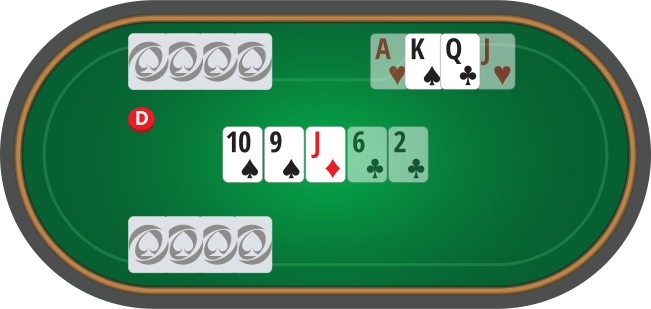
Of those four hole cards, players must choose two to be used in combination with three of the five community cards to build their five-card poker hands.
Yes. In a game of Omaha poker, each player must use two of their hole cards and three of the community cards to build a poker hand.
That's different from hold'em where players can use:
- both of their hole cards (and three community cards),
- just one hole card (and four community cards),
- or no hole cards (and all five community cards, which is called "playing the board").
In pot-limit Omaha, the poker hand rankings are just the same as in Texas hold'em.
Like hold'em, pot-limit Omaha or 'PLO' poker is played as a 'high-hand' game, which means the hands go (from best to worst):
- royal flush
- straight flush
- four-of-a-kind
- full house
- flush
- straight
- three-of-a-kind
- two pair
- one pair
- high-card.
Other Omaha Poker Tips
The Importance of 'Position'
Just like in hold'em, poker positioning is an important element in Omaha.
Many consider this aspect of the game to be even more important in Omaha poker. That's due to the the pot-limit betting format and all the combinations a player can make with an Omaha hand.
When you have 'position' on your opponents, you can follow their actions and base your decisions on the information you received.
When you are out of position, it becomes much harder to make the correct decisions. The lack of information can lead to wrongful assumptions and push you to take risks that are not justified by the value of the cards you hold.
Another benefit of being in position is that you have a better chance of controlling the size of the pot, which is often based on the strength of your hand and your overall goal in the pot.
Being out of position to one or more opponents gives them the ability to control the pot size and also capitalize on the added information of knowing your actions first.
Bluffing in Omaha Poker
Because Omaha is so focused on the nuts, it might seem like bluffing plays an important role in the game.
A player can represent a wider range of hands in Omaha, and also open up with a bit more with so many more semi-bluffs available.
In fact, experienced Omaha players will often bet big draws heavily on the flop, since in some cases those draws are actually mathematical favorites versus made hands.
All of which is to say players do bluff in pot-limit Omaha, but with so many possible hands out there you have to be judicious when deciding when it is best to bluff.
The more you learn about the game, the easier it will become to pick up on these spots and determine how to proceed against various opponents.
Be Wary of the Blockers
Relatedly, blockers also become much more prevalent in Omaha than in Texas hold'em.
Blockers are those cards you hold in your hand that prevent an opponent from making a specific hand.
For example, if a board reads K♠10♠5♥2♠4♦ and you hold the A♠ in your hand but no other spades, you may not have a flush, but you know your opponent cannot make the nut flush.
This gives you added power in the hand being able to push your opponent off certain hands as your opponent is guaranteed to not contain the nuts.
5. Where to Play Omaha Poker Games Online
Like you would expect for a popular game like Omaha poker, you'll find PLO games at all the major poker sites online.
All the 'must-have' poker rooms listed below offer a very good selection of PLO games, with plenty of beginner-friendly free games.
Pick one of them, register a free account, and use the PokerNews-exclusive welcome bonus to pay for your first real money games of Omaha poker online.
Omaha Poker Rules FAQs
Is Omaha Poker the same as Texas Hold'em?
No, Omaha Poker and Texas Hold'em are distinct poker variants. In Omaha, players are dealt four hole cards instead of two.
How is Omaha Poker played?
Omaha Poker is played similarly to Texas Hold'em, with the main difference being that players use two of their four hole cards and three of the five community cards to make the best hand.
What are the starting hands to play in Omaha?
Good starting hands in Omaha typically include those with connected cards and high potential. Hands with pairs and coordinated suits are often preferred.
What is the best strategy for playing Omaha Poker?
A successful Omaha strategy involves understanding the importance of starting hands, position, and adapting to community cards. Players need to be mindful of potential high hands.
How does the betting work in Omaha Poker?
Omaha Poker features betting rounds similar to Texas Hold'em. Players can check, bet, raise, or fold during each round, and the game includes pre-flop, flop, turn, and river.
Can I play Omaha Poker online for real money?
Yes, many online poker platforms offer Omaha Poker games for real money. Ensure you choose a reputable and licensed platform for a secure gaming experience.
What are the common mistakes to avoid in Omaha Poker?
Common mistakes include overvaluing hands that are only strong for high, neglecting the importance of community cards, and not adjusting strategies based on the game variant (Omaha Hi).
Do you burn cards in Omaha Poker?
No, in Omaha Poker, it is not common practice to burn cards. Burning cards, which involves discarding the top card from the deck before dealing the community cards, is a procedure often followed in some variations of Texas Hold'em to prevent cheating or card marking. However, Omaha Poker typically does not include this practice. In Omaha, each player receives four hole cards, and the community cards are dealt without burning a card between rounds.